May 13, 2011

Explaining "pain" to your clients and athletes: A guide for trainers and coaches


If you have been in the fitness/coaching industry long enough, you will have dealt with a client or athlete who is in pain whether it is acute or chronic. If it hasn't happened yet, it will at some point.

Even if you have or have not had a client or athlete in pain, you have most likely experienced it yourself. Chronic. Acute. Or both.

However, do you really understand what "pain" really is and what is going on in the body.

Here is a TRAINER/COACHES GUIDE TO PAIN with special thanks to Diane Jacobs and the folks at somasimple.com for their information and support.


DESCARTES AND HIS THEORY

About 400 years ago, a smart French philosopher by the name of Rene Descartes came up with the idea that PAIN was created by peripheral sensors in the body that sent "pain" messages to that brain. Basically, if you stubbed your toe, an "alarm bell" of some type rings your brain. However, this proved to not be the case.

In the last 50 or so years, pain science research has come out that opens our eyes to the true cause of "pain." Led by pioneers like Ronald Melzack and Patrick Wall, we have newer and workable theory of pain which is now being known as Melzacks Neuromatrix Theory. However, I will go over this in more detail at a later time. Right now, I want to give you an overview of Pain as we understand it now.


NOCICEPTION DOES NOT EQUAL PAIN


This is probably where most people, including myself, get tripped up a bit. We think, we bang our knee and then BOOM, there's pain. Well, turns out its more complicated than that. Here are a few things to keep in mind:

1) First, recognize that pain and nociception are terms that are often used interchangeably unfortunately, so please bare with me while I deconstruct the above bolded statement. 


2) Pain CAN exist without any nociception. For instance, there are many documented cases and a tremendous amount of research done about PHANTOM LIMB PAIN where there is no limb but there is a perceived pain where that limb would be. Luckily thanks to the pioneering efforts of doctors like V.S. Ramanchandran  and Mirror Box Therapy, many of those afflicted with Phantom Limb Pain have been helped. 

3) If there is pain, the brain can choose to ignore it given the circumstances. There are well documented cases of soldiers who have been wounded on the battlefield and kept on fighting. Not until they ceased fighting did the body experience "pain" because the situation of staying alive throughout the battled overrode the pain perception. Same things happen in the wild to animals like zebra who have been wounded by a lion but still keeps running, if possible.

4) Nociceptive input is required for the developing infant brain so that starts to create an experience of pain. There is an disorder called congenital insensitivity to pain where a person can feel no pain. This is especially dangerous for young children as any infections, broken bones, burns, etc go unfelt by the child  and there is a greater risk of them dying young. 

According to the International Association for the Study of Pain, "PAIN" is defined as:

"Pain is an unpleasant sensory and emotional experience associated with actual or potential tissue damage or described in terms of such damage."

Wait! Pain is an EXPERIENCE and not some sense???? 

Yes, that's pretty much what it is. It was once thought that pain nerves in the body would send signals through the spinal cord to the a pain center in the brain much like the way the visual, auditory, gustatory, etc senses worked. However, this is not the case. 

According to Diane Jacobs, PT: Instead [of a pain center] there are circuitry routes, billions of neurons, receptor sites on them (lots and lots of receptors that can change to different ones, alter what they are sensitive to, thanks to "synaptic plasticity") and transmitters. There are convergence zones and arborizations, ascending and descending fibers, switchback and feed forward stations, and lots of somatotopic representational areas (brain maps of body parts). There is brain behaviour, and parts or areas that light up for pain as well as for other functions on fMRI. But there is no verifiable "pain center," a center devoted exclusively to receiving pain signals, same as there is no actual "little wo/man", or mayor, up there running anything or guiding our lives.

SO WHERE DOES PAIN COME FROM THEN???


May 7, 2011

Music as Medicine through this world of woe: Focus on Dopamine


Peter Hollens has done it again. What can i say but the boy's got talent! His latest a cappella single "Poor Wayfaring Stranger" was amazingly powerful and moving. Of course with my new found respect for being a "neuro-head" I had to investigate why I was so moved by this music.


This led me to a search on google that resulted in an article from MSNBC.com entitled "To your brain, music is as enjoyable as sex." BINGO!  In this article, the researchers from McGill University focused on just the neurotransmitter, DOPAMINE  that was released during listening to classical music. Among other things, they found that "The brain substance is involved both in anticipating a particularly thrilling musical moment and in feeling the rush from it, researchers found," and "while dopamine normally helps us feel the pleasure of eating or having sex, it also helps produce euphoria from illegal drugs. It's active in particular circuits of the brain."


So wait...just listening to music can make me feel happy? Sure, I think that people have known that for centuries. The adage "Music soothes the savage beast" captures that perfectly.  It seems that dopamine's effects were known in the 1800's by Angelo Masso, an Italian physiologist, and later confirmed that dopamine not only acted as neurotransmitter but worked as a a vasopressor 

WHOAAAA! Wait, dopamine secreted while listening to music creates an entire physiologic experience of pleasure not to mention a potential stir of emotions, depending on the context of the music? Dr. Robert Zatorre of McGill University said "that makes sense: The area linked to anticipation connects with parts of the brain involved with making predictions and responding to the environment, while the area reacting to the peak moment itself is linked to the brain's limbic system, which is involved in emotion.


Dopamine, secreted by the Hypothalamus which is intimately tied in with the Pituitary gland that leads to other glands like the Adrenals, Gonads and Thyroid (the whole Hypothalimic - Pituitiary Axis) is affected by something as common as music? 


Wait! The hypothalamus that is intimately linked to our Autonomic Nervous System that controls bodily functions like heart rate, blood pressure, body temperature is stimulated by MUSIC?


Can music make you happier? Sure does look that way. In an article from WIRED entitled "Music makes your brain happy", Dr. Daniel Levitin, another McGill University adjunct professor, also believes that serotonin and dopamine are involved while listening to music with the ability to act like anti-depressants.  According to Levitin:  ...most people in Western society use music to regulate moods, whether it's playing something peppy in the morning or something soothing at the end of a hard day, or something that will motivate them to exercise.  Joni Mitchell told me that someone once said before there was Prozac, there was her."


I invite you listen to the video below and buy the single from iTunes. Pete is a great musician who, like many musicians, is trying to make a living while following his passion. 


Enjoy and be happy!


Will


<


Lyrics

I'm just a poor wayfaring stranger
While traveling through, this world of woe.
Yet there's no sickness, toil nor danger
In that bright land, to which I go.
I'm going there to see my father
I'm going there no more to roam;
I'm just a going over Jordan
I'm just a going over home.

I know dark clouds will gather o'er me
I know my way is rough and steep;
Yet beauteous fields lie just before me
Where God's redeemed, their vigils keep
I'm going there to see my mother
She said she'd meet me when I come;
I'm just a going over Jordan
I'm just a going over home.

I want to wear a crown of Glory
When I get home to that good land
I want to shout Salvation's story
In concert with the Blood-Washed Band
I'm going there to meet my Saviour
To sing his praise forever more;
I'm just a going over Jordan
I'm just a going over home.

May 5, 2011

Pavlov's Yogis?: Redefining your space through Neuroplasticity


How do you define your yoga practice? I think the better question is "How do you redefine your yoga practice?"

I do not think there is one particular answer but the one I have been focusing on in my yoga classes is one of SPACE and SPACING. It seems when many of us go to a class, we grab our mats and go to the same place as the last time we were there. We like our "spots" and given going to that same spot more and more, we become accustomed to it and even feel "weird" when we are not in it, despite the fact it's the same room.

I think that probably happens in more than just the yoga studio. Classrooms, boardrooms, treadmills at the gym to even airplane seats. We are "creatures of habit" in so many ways. However, is that advantageous during our yoga practice and lives off of the mat?

Well, I could argue both ways but for the sake of today's post, I will go with a NO!

I have observed over the last few weeks that not only are my students setting themselves up the same way in the room (fine by me) but they are actually moving in, remaining and moving out of the asana in the same way and positioning their hands and feet the same way (not fine by me). Looking at the function of the CEREBELLUM, we become aware of how powerful the brain is in terms of learning in anything, in particular yoga.  In the book "Brain Architecture" by Larry Swanson, we see that the brain "The essential nature of cerebellar function remains elusive. However it does appear safe to conclude that the “small brain” is an integral part of the motor system (it is also known to participate in visceromotor responses) and that it plays an important role in motor learning and in fine tuning the coordination between the hundreds of muscles involved in orienting responses, reaching and manipulating, posture, and so on. The cerebellum receives all types of sensory information, either directly from the spinal cord and brainstem or indirectly from the cerebral cortex (via mossy fibers from the pontine gray). " 


We also see "Much more intriguing, however, is the possibility that synaptic strength can be increased or decreased by the coincident activation of synapses: in other words, that associate learning can take place. As a matter of fact, Richard Thompson and his colleagues have shown that the circuit  underlies at least some forms of Pavlovian learning, which is also referred to as classical conditioning. Recall Pavlov’s dogs and how they salivated at the sight of food (an unconditioned stimulus and response). What Pavlov did was to ring a bell just before food was shown to the dog, and the next time the bell was rung alone the dog salivated. Before the pairing, the bell alone did not elicit salivation; after the pairing, it did – it became a conditioned or learned stimulus that produced a conditioned response. The key point was that an ineffective stimulus (the bell) became an effective stimulus after pairing with an unconditioned or already effective stimulus. We now know that the strength of synapses associated with the auditory pathway were strengthened to the point where they were now effective without pairing with the other stimulus. Where does this synaptic strengthening – this learning – take place?"


Are yogis victims of "classical conditioning" that the mat is the effective stimulus to have them position and move themselves the same way EVERY TIME? I offer the some thoughts that we can not only develop our body, we can develop our minds via neuroplasticity. 


In the book "The Brain that Changes itself" by Dr. Norman Doidge, we see a great interview with Dr. Michael Menzerich  who discusses the reality that the brain is able to be changed, even in adulthood, for the better and it is not "hard-wired" as previously thought. Turns out you can teach an old dog new tricks, but it's harder due to "competitive plasticity" which "explains why our bad habits are so difficult to break or “unlearn.” Most of us think of the brain as a container and learning as putting something in it. When we try to break a bad habit, we think the solution is to put something new into the container. But when we learn a bad habit, it takes over a brain map, and each time we repeat it, it claims more control of that map and prevents the use of that space for “good” habits. That is why “unlearning” is often a lot harder than learning, and why early childhood education is so important— it’s best to get it right early, before the “bad habit” gets a competitive advantage.

As we move through our yoga practice, make sure that you are changing the physical and MENTAL dimensions of your practice by doing the following:

1) Be "longer" in your poses, meaning increase the length of how far the feet are apart from each other. For instance, step 2 more inches forward of where you normally do in Standing poses like Virhrabandrasana I (Warrior I). (More sensory feedback for greater motor output)

2) Be "deeper" in your poses by bending your knees, within a safe range, to allow the muscles to elongate at the same time stabilizing you more. (More sensory feedback for greater motor output)

3) Be "slower" while moving into, through and out of your poses. The brain will want to move in/out of the pose quickly since the "pose" and not the transition is the goal. Be aware of your speed so that the brain fires to more muscle fibers so that start to develop greater strength. (More sensory feedback for greater motor output)

4) Breathe deeper. Enough said.

5) Focus


Merzenich discovered that paying close attention is essential to long-term plastic change. In numerous experiments he found that lasting changes occurred only when his monkeys paid close attention. When the animals performed tasks automatically, without paying attention, they changed their brain maps, but the changes did not last. We often praise “the ability to multitask.” While you can learn when you divide your attention, divided attention doesn’t lead to abiding change in your brain maps.


Warning: This will be difficult at first. For some, including myself, change is not hard. It's easier to use those highly used neural pathways. However, as we are more focused on the changing the brain, I promise you that the body will follow and you will see your practice soar!

Questions? Comments? I'd love to hear them!

Will

May 3, 2011

Focus on the movement and not the exercise


It's been a while since I wrote about athletic performance enhancement so I figured I'd go ahead and do it today.  In case you haven't gathered from my recent posts, I am focusing on the Nervous System which is pretty cool. 

My colleagues are a little perplexed, maybe even a little intimidated by this topic because it is VERY in-depth. Muscles, joints, fascia, are all fascinating subjects, don't get me wrong and for MANY, MANY years coaches have been focusing on those because it's the easiest to see (and maybe understand). However, as I look at my preparation for training my athletes this summer, I see an advantage to being much more MINDFUL of movements and not exercises. 

If you have been a long time reader of the blog, you will see that I am heavily involved in biomechanics and the movements of the joints, eccentric loading/concentric unloading of muscles, etc. Both are very important to performance enhancement because we need to know what is going on at any given time during the movement. That way, if our athlete is experiencing a physical limitation, we have some kind of starting point with the movement. We take into considerations like GRAVITY, GROUND REACTION FORCES, MASS, MOMENTUM. All of those physics-based variables. Biologically, we understand arthrokinematics and muscle function. We also need to take into account the other bodily systems like Endocrine, Immune and Nervous systems. If an athlete is hitting a plateau, those integrated systems are the places to look. Not more weight/load on the athlete. 

Is it possible that the allostatic load of the athlete is unbalanced from all of the training?I have seen athletes being driven into the ground during off season workouts only to crack under the pressure of the season. All that work for nothing! 

At 3-D Optimal Performance we offer a program that takes into consideration the needs and wants of the athlete and balances them out in a week long program that consists of:

Strength Training
Cardiovascular Conditioning
Aquatic Conditioning
Yoga/Pilates
Martial Arts
Speed and Agility Training

We do this to stimulate performance enhancement by providing novel stimuls to the athletes system so that it is not able to adapt unlike the painful and repetitive Bench Press-Squat-Deadlift routine. 

Our athletes CONSISTENTLY score high on the strength tests their schools put them through despite never lifting heavy and stay injury free (minus trauma based injuries). 

Challenge the body by challenging the brain. 

Highs and Lows in Training.

Make them think.

Make them adapt.

Make them love movement so when they get on the field it's there without hesitation.

Make them breathe and be calm so when they are in clutch situation, they don't panic.

Educate them on proper nutrition. Basic physiology doesnt change. Eat crap. Play like crap. 

Focus on the movement and not the exercise. 

Simple? Simple.


April 28, 2011

Here's what the Dalai Lama thinks about humanity....


The Dalai Lama, when asked what surprised him most about humanity, answered:

"Man. Because he sacrifices his health in order to make money. Then he sacrifices money to recuperate his health. And then he is so anxious about the future that he does not enjoy the present; the result being that he does not live in the present or the future; he lives as if he is never going to die, and then dies having never really lived."

Dalai Lama (1935- ), 14th and current Dalai Lama; Dalai Lamas are the most influential figures in the Gelugpa lineage of Tibetan Buddhism

April 21, 2011

My Neural Path Way: My journey from a meat-head to a neuro-head

Recently, I have had a life changing moment. It was all brought on about by a workshop I participated in about 3 months ago regarding Kinesiotape and how to apply it in rehabiliation and performance enhancement.

This workshop was facilitated by my friend and colleague, Dr. Nick Studholme, DC. Of course, we started with the neurophysiology of the Kinesiotape, of which I'll go over in another post, which really excited me. I had already been awakened to the possibility that the body is run by the body's president, the brain by another friend, Dr. Peter Jo, DC. During the summer we discussed, in detail, how the nervous system is the key to the body and how it is important that the we address the nervous system when we look at the body; otherwise, we are missing a huge component.

Well, many books and websites later, I finally found Diane Jacobs and the folks at SomaSimple.com who really got me thinking. They are a group of manual therapy physical therapists, massage therapists and even a few strength coaches and chiropractors who have created a pretty amazing forum dedicated to understanding neuroscience and how it relates to pain elimination/management but easily be applied to performance enhancement especially when so many athletes are in pain.... A LOT.

1 - blastula, 2 - gastrula with blastopore;orange - ectoderm, red - endoderm.
On the forum, they frequently refer to ectoderm and mesoderm. These terms are based in embryology and describe the progression of development of the embryo to maturation with the ectoderm (nervous system, skin)  and the endoderm (digestive organs, lungs, bladder) developing first and THEN the mesoderm (muscles, skeleton and blood systems). Because of this order of development, it seems working with the ECTODERM or nervous system, makes more sense than trying to work with muscles or joints or the MESODERM for a truly functional outcome.

However, MANY in the rehabilitation and strength and conditioning fields are "mesodermalists". They insist that the muscles, joints, ligaments, tendons and fascia are the sources of pain and dysfunction. Treating or training them is the primary focus of many and while they may acknowledge the existence of the nervous system, it seems to be in a more "Oh of course it's important" and then go right back to focusing on joint mobilization/manipulation, ultrasound, deep tissue massage (read: beating), and in training focusing on isolated muscle building, foam rolling to "prep tissues", and joint mobility work.

All well intentioned but what I have learned in working with neuroscience or being an ECTODERMALIST, is that the brain can do all the heavy lifting (no pun intended) in terms of rehab AND training.

WHOA! WHOA! WHOA! I know that probably got some feathers ruffled but it's unfortunately the case folks. Now in terms of strength, sure,  you can't just think yourself strong. You have to obviously increase the demands of load upon the organism to stimulate 'hypertrophy". I totally get that. However, how is that that the signals are sent that stimulates all the necessary metabolic changes to take place? How are type I or type II fibers "recruited?"

Hint: Nervous system.

How about in terms of pain in rehab? Well, just reading Melzacks Neuromatrix  will clue you into that pain is an OUTPUT from the brain and not an input to the brain. This totally changed the way I treated pain along with thinking ectodermally.

I have been getting so much better results while just working with the skin and a technique developed by Diane Jacobs, PT called DERMONEUROMODULATION than digging into fascia or muscles. I simply let the brain do the work. There is no need to cause more pain with these techniques to the patients especially when muscles are just meat and fascia is just structural support. They do not signal the brain themselves. They are simply innervated.

As we look a little closer at training, many coaches say that they are doing "functional training," which is a dirty word in some regards but has become so widely misunderstood, the truly functional training coaches like Vern Gambetta, barely use it anymore. However, I am not sure they are sure who actually sits in the seat of "function." Here's another hint:

It's the nervous system.


I could go on and on about it, but I don't think more details are necessary, at least not in this post. This post was meant to stimulate some deeper thinking on the subject of the Nervous System as the "President of the body". Sure, he can't go at it without support from other departments like the vascular system, the cardiopulmonary system, etc,  BUT he's still the "PREZ".

Thoughts? Questions?

Let me know.

Will

April 7, 2011

Introduction to Neural Training for Athletics: Focus on Baseball


I've been sitting here for about an hour racking my brain thinking about baseball.  It is THE season now and it's all over ESPN, so like the flu, I was bound to catch BASEBALL FEVER sooner or later.

Anyway, as I move through my studies of the body, I have made my way through the field of biomechanics and now have landed at HOME BASE (pardon the pun) of THE NERVOUS SYSTEM.

Thanks for a pioneering group of PT's at SOMA SIMPLE, I have been truly enlightened. My realization:

THE BRAIN RUNS EVERYTHING IN THE BODY. You can live without many body parts and organs but life will cease instantly with no brain. 


As I look at the field of baseball, I see that most to all of the focus is on the strengthening and conditioning of muscles and joints.  Some coaches have even focused on the now very popular FASCIA and it's many wonderments. Anatomy trains has a foothold on many trainers and coaches now. It's fine to be interested in it but guess what....THE BRAIN RUNS EVERYTHING. No matter how well you understand fascia, if you don't have the brain to facilitate the task, you are dead in the water. Sorry to break it to you!

Anyway, I was reading a great article on a Belgian soccer coach by the name of Michel Bruyninckx entitled "Cracking Coaching's final frontier". In this article, the coach describes using "brain centered learning" as a way to train his players and its effects on his players.  "When Germinal Beerschot and Belgian international midfielder Faris Haroun came to work with Bruyninckx, he could not kick the ball with his left foot. Two years later his former club Racing Genk thought he was left-footed"


According to the article "His drills start off simply but become increasingly more complicated to challenge players' focus and maintain their concentration. Sometimes players train in bare feet to make them more "sensorially" aware; at other times they would play simple maths games while doing physical conditioning work."
Wow! A sports coach who is having success with focusing his training on the brain. I HAD to learn more. 

WHAT DOES THIS HAVE TO DO WITH BASEBALL? 
Well, it has everything to do with baseball or any other sport for that matter. As I mentioned before, the brain runs the show and when we take a complicated action like pitching, we MUST figure that into the equation. Its not just muscles, fascia and bones! 
Current USC baseball pitching coach Tom House has written a great book on pitching called " Arm Action, Arm Path, and the Perfect Pitch: Building a million dollar arm"
 and in the first chapter of the book, he discusses what he calls "Timing of the RDRBI Mechanics Variables with the Progression of Critical Events in a Pitchers Delivery". He cites 3 functions of optimal kinematic/kinetic efficiency in a pitchers delivery being: 
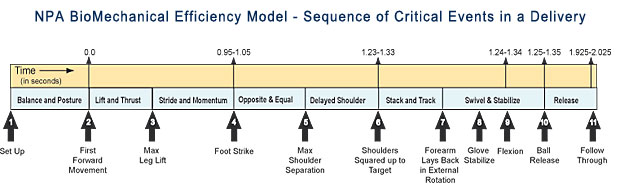
A. Timing
B. The RDRBI Bio-mechanical variables with
C. The proper sequencing of critical events. 


I'd like to focus on TIMING. I realize that there some disagreements with Coach House's sequencing but  I will leave that for another time. Any comments to that can be directed to him. :)


TIMING AND PERCEPTION IN BASEBALL:


As we look towards the skill of baseball, it is easy to break down component parts of the full movement from Set-up to the Follow-through. According to Coach House, there are particular points in time WITHIN the sequence of events that need to occur in a very narrow window of time. These numbers are for elite baseball players and will probably modulate given age and competitive level but they will most not likely deviate too much. However, our sense of "time" and "timing" in sports is integral to our success. In a complex action, like pitching, our brain and body have to be tuned into time or COORDINATED. This "time sense" of course is subconscious, but this should not downplay its importance. 


In a task, there is an inherent rhythm to the movements kept in step by our brain. If that sense of timing is off, then no matter what sequencing we use, it will not be as efficient and more than likely not as effective. This matter of timing is critical in both learning and performing. 


NEUROSCIENCE MEETS SPORTS


Science is now telling us that there are neurons devoted to the sensing of time which are located in the prefrontal cortex and striatum. In an article entitled "Time Keeping Brain Neurons Discovered"  based on the journal paper "Neural representation of time in cortico-basal ganglia circuits" , it suggests that part of the brain actually time stamps tasks that didn't require a specific time requirement; and that the task had dominant peaks in latencies at 100 milliseconds, 110 miliseconds, 150 milliseconds, etc after the initiation of a "go" signal. Interestingly, the neurons that are located in the prefrontal cortex and striatum also play important roles in movement, thought control and learning. 


WHAT!??!?!?!? Is is possible there are subtle peaks times in the brain for optimal learning, thought control and movement??????


BUT WAIT...THERE'S MORE.....


In a study in the Journal of Neuroscience, the researchers found that PERCEPTION has 'on' and 'off' periods where attention is a at its greatest. According to the article, "Timewarp: How your brain creates the 4th Dimension"  "[Prof] VanRullen examined another neural function, called near-threshold luminance detection. He exposed his subjects to flashes of light barely bright enough to see, and found that the likelihood of them noticing the light depended on the phase of another wave in the front of the brain, which rises and falls about 7 times per second. It turned out that subjects were more likely to detect the flash when the wave was near its trough, and miss it when the wave was near its peak."


WHERE IS THIS GOING....


Ok, I know some of the above info was a little dense BUT I am getting to what it has to do with baseball and sports in general. 


As we teach our athletes, students and musicians a skill, it is important for us to recognize that we can access the brain directly to accelerate learning. For instance, Dr. Luke Jones from the University of Manchester discovered that performance of certain tasks could be improved up to 20 percent by causing the internal clock of the brain to speed up artificially by using 10 seconds of clicks (about 5 clicks per second) to stimulate neurons in the brain. TWENTY PERCENT!?!?!?

The theory behind it is that if you accelerate peoples subjective time, "they really seem to have more time to process things," according to Dr. John Wearden, a mentor of Dr. Jones. That's the feeling of the ZONE when everything slows down and you can see things almost moving in slow motion. 

The implications in both learning skills and performance are enormous with the knowledge that we can directly affect the brain through something as simple as clicks on a metronome to improve performance. 

ARE THERE OTHER WAYS TO TWEAK THE BRAIN TO IMPROVE PERFORMANCE? 

Of course! The "Timewarp" article says that  "Edward Large, a neuroscientist at Florida Atlantic University at Boca Raton, has found that rhythmic sounds (like that found in music) can entrain gamma brain waves, causing the beginning of each sound to be accompanied by a burst of several especially strong wave peaks. The click train may entrain other types of brain waves too - perhaps those that correspond to the discrete snapshots in our perceptions. 

VanRullen and Jones agree that this may be the answer. "When you have faster oscillations, you have more snapshots per second," says VanRullen. "You may be more efficient at particular cognitive tasks, and because there are more snapshots in a given time, it may seem to last for longer.  If this theory is correct, the click train is literally resetting the brain's frame-capture rate." 


SHOTGUN TECHNIQUE: 


1) Find an online metronome or download something to your smart phone. I have an app called Tempo on my iphone.
2) Set the metronome to about 250 beats per minute (bpm) in 4/4 time using the quarter note as the beat.
3) Try not to have any distractions on music. The rhythm and tempo of the music will affect the experiment. 
4) Compose of 2 sets of of 10 arithmetic problems. They should be all addition, subtraction, multiplication, division, etc. Try not to mix. 
5) Time yourself on how long it takes you to complete the first set
6) With a stopwatch listen to your metronome for 10 seconds at 250 bpm. 
5) Immediately time yourself doing set #2 of the arithmetic problems. 


Where you better on the second set? 


Could this be used when you doing other skill builidng? 


CONCLUSION


Myelination of a neuron
We know that the brain controls everything, so when we can start to understand and accept that, it opens up a whole new world to training like Coach Bruyninckx did. With the "brain centered training" we know that all skills are learned in a progression. When one step of that progression is weak, we will see a breakdown at SOME point of the complete skill. As we begin skills, we learn them in a slower approach and then begin to tweak variables like speed, distance and time. As the brain becomes comfortable with the one step of the skill, an athlete, or whoever, can start to layer and fine tune that step ("myelination")  which will create a natural transition to the next step. Until all steps are learned in an integrated fashion to produce something like an effective and efficient baseball pitch.  


OBVIOUSLY, we cannot stop focusing on the biomechanics, muscle strengthening, fascial connections, etc that is associated with sports. They have their place. Knowing joint positions and muscular eccentric and concentric movements helps us to understand the the positions and snap shots of the task; however, what is important is what is "controlling the puppet strings". 

THE BRAIN. THE BRAIN. THE BRAIN. 


If team, skills and strength coaches recognize this, their results could improve 10-20 percent! Hmmm....I wonder if that's the difference between winning and losing a championship game? You tell me!!!


Thoughts? I'd love to hear them!


Have a great day!


Will