
I've been sitting here for about an hour racking my brain thinking about baseball. It is THE season now and it's all over ESPN, so like the flu, I was bound to catch BASEBALL FEVER sooner or later.
Anyway, as I move through my studies of the body, I have made my way through the field of biomechanics and now have landed at HOME BASE (pardon the pun) of THE NERVOUS SYSTEM.
Thanks for a pioneering group of PT's at SOMA SIMPLE, I have been truly enlightened. My realization:
THE BRAIN RUNS EVERYTHING IN THE BODY. You can live without many body parts and organs but life will cease instantly with no brain.
Anyway, I was reading a great article on a Belgian soccer coach by the name of Michel Bruyninckx entitled "Cracking Coaching's final frontier". In this article, the coach describes using "brain centered learning" as a way to train his players and its effects on his players. "When Germinal Beerschot and Belgian international midfielder Faris Haroun came to work with Bruyninckx, he could not kick the ball with his left foot. Two years later his former club Racing Genk thought he was left-footed"
According to the article "His drills start off simply but become increasingly more complicated to challenge players' focus and maintain their concentration. Sometimes players train in bare feet to make them more "sensorially" aware; at other times they would play simple maths games while doing physical conditioning work."
Wow! A sports coach who is having success with focusing his training on the brain. I HAD to learn more.
WHAT DOES THIS HAVE TO DO WITH BASEBALL?
Well, it has everything to do with baseball or any other sport for that matter. As I mentioned before, the brain runs the show and when we take a complicated action like pitching, we MUST figure that into the equation. Its not just muscles, fascia and bones!
Current USC baseball pitching coach Tom House has written a great book on pitching called " Arm Action, Arm Path, and the Perfect Pitch: Building a million dollar arm"
 and in the first chapter of the book, he discusses what he calls "Timing of the RDRBI Mechanics Variables with the Progression of Critical Events in a Pitchers Delivery". He cites 3 functions of optimal kinematic/kinetic efficiency in a pitchers delivery being:
 A. Timing
B. The RDRBI Bio-mechanical variables with
C. The proper sequencing of critical events.
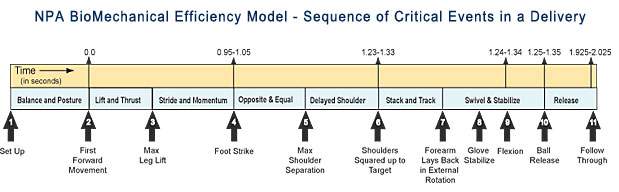
I'd like to focus on TIMING. I realize that there some disagreements with Coach House's sequencing but I will leave that for another time. Any comments to that can be directed to him. :)
TIMING AND PERCEPTION IN BASEBALL:
As we look towards the skill of baseball, it is easy to break down component parts of the full movement from Set-up to the Follow-through. According to Coach House, there are particular points in time WITHIN the sequence of events that need to occur in a very narrow window of time. These numbers are for elite baseball players and will probably modulate given age and competitive level but they will most not likely deviate too much. However, our sense of "time" and "timing" in sports is integral to our success. In a complex action, like pitching, our brain and body have to be tuned into time or COORDINATED. This "time sense" of course is subconscious, but this should not downplay its importance.
In a task, there is an inherent rhythm to the movements kept in step by our brain. If that sense of timing is off, then no matter what sequencing we use, it will not be as efficient and more than likely not as effective. This matter of timing is critical in both learning and performing.
NEUROSCIENCE MEETS SPORTS
Science is now telling us that there are neurons devoted to the sensing of time which are located in the prefrontal cortex and striatum. In an article entitled "Time Keeping Brain Neurons Discovered" based on the journal paper "Neural representation of time in cortico-basal ganglia circuits" , it suggests that part of the brain actually time stamps tasks that didn't require a specific time requirement; and that the task had dominant peaks in latencies at 100 milliseconds, 110 miliseconds, 150 milliseconds, etc after the initiation of a "go" signal. Interestingly, the neurons that are located in the prefrontal cortex and striatum also play important roles in movement, thought control and learning.
WHAT!??!?!?!? Is is possible there are subtle peaks times in the brain for optimal learning, thought control and movement??????
BUT WAIT...THERE'S MORE.....
In a study in the Journal of Neuroscience, the researchers found that PERCEPTION has 'on' and 'off' periods where attention is a at its greatest. According to the article, "Timewarp: How your brain creates the 4th Dimension" "[Prof] VanRullen examined another neural function, called near-threshold luminance detection. He exposed his subjects to flashes of light barely bright enough to see, and found that the likelihood of them noticing the light depended on the phase of another wave in the front of the brain, which rises and falls about 7 times per second. It turned out that subjects were more likely to detect the flash when the wave was near its trough, and miss it when the wave was near its peak."
WHERE IS THIS GOING....
Ok, I know some of the above info was a little dense BUT I am getting to what it has to do with baseball and sports in general.
As we teach our athletes, students and musicians a skill, it is important for us to recognize that we can access the brain directly to accelerate learning. For instance, Dr. Luke Jones from the University of Manchester discovered that performance of certain tasks could be improved up to 20 percent by causing the internal clock of the brain to speed up artificially by using 10 seconds of clicks (about 5 clicks per second) to stimulate neurons in the brain. TWENTY PERCENT!?!?!?
The theory behind it is that if you accelerate peoples subjective time, "they really seem to have more time to process things," according to Dr. John Wearden, a mentor of Dr. Jones. That's the feeling of the ZONE when everything slows down and you can see things almost moving in slow motion.
The implications in both learning skills and performance are enormous with the knowledge that we can directly affect the brain through something as simple as clicks on a metronome to improve performance.
ARE THERE OTHER WAYS TO TWEAK THE BRAIN TO IMPROVE PERFORMANCE?
Of course! The "Timewarp" article says that "Edward Large, a neuroscientist at Florida Atlantic University at Boca Raton, has found that rhythmic sounds (like that found in music) can entrain gamma brain waves, causing the beginning of each sound to be accompanied by a burst of several especially strong wave peaks. The click train may entrain other types of brain waves too - perhaps those that correspond to the discrete snapshots in our perceptions.
VanRullen and Jones agree that this may be the answer. "When you have faster oscillations, you have more snapshots per second," says VanRullen. "You may be more efficient at particular cognitive tasks, and because there are more snapshots in a given time, it may seem to last for longer. If this theory is correct, the click train is literally resetting the brain's frame-capture rate."
SHOTGUN TECHNIQUE:
1) Find an online metronome or download something to your smart phone. I have an app called Tempo on my iphone.
2) Set the metronome to about 250 beats per minute (bpm) in 4/4 time using the quarter note as the beat.
3) Try not to have any distractions on music. The rhythm and tempo of the music will affect the experiment.
4) Compose of 2 sets of of 10 arithmetic problems. They should be all addition, subtraction, multiplication, division, etc. Try not to mix.
5) Time yourself on how long it takes you to complete the first set
6) With a stopwatch listen to your metronome for 10 seconds at 250 bpm.
5) Immediately time yourself doing set #2 of the arithmetic problems.
Where you better on the second set?
Could this be used when you doing other skill builidng?
CONCLUSION
 |
| Myelination of a neuron |
OBVIOUSLY, we cannot stop focusing on the biomechanics, muscle strengthening, fascial connections, etc that is associated with sports. They have their place. Knowing joint positions and muscular eccentric and concentric movements helps us to understand the the positions and snap shots of the task; however, what is important is what is "controlling the puppet strings".
THE BRAIN. THE BRAIN. THE BRAIN.
If team, skills and strength coaches recognize this, their results could improve 10-20 percent! Hmmm....I wonder if that's the difference between winning and losing a championship game? You tell me!!!
Thoughts? I'd love to hear them!
Have a great day!
Will


