Showing posts with label Movement Focus. Show all posts

April 7, 2011

Introduction to Neural Training for Athletics: Focus on Baseball


I've been sitting here for about an hour racking my brain thinking about baseball.  It is THE season now and it's all over ESPN, so like the flu, I was bound to catch BASEBALL FEVER sooner or later.

Anyway, as I move through my studies of the body, I have made my way through the field of biomechanics and now have landed at HOME BASE (pardon the pun) of THE NERVOUS SYSTEM.

Thanks for a pioneering group of PT's at SOMA SIMPLE, I have been truly enlightened. My realization:

THE BRAIN RUNS EVERYTHING IN THE BODY. You can live without many body parts and organs but life will cease instantly with no brain. 


As I look at the field of baseball, I see that most to all of the focus is on the strengthening and conditioning of muscles and joints.  Some coaches have even focused on the now very popular FASCIA and it's many wonderments. Anatomy trains has a foothold on many trainers and coaches now. It's fine to be interested in it but guess what....THE BRAIN RUNS EVERYTHING. No matter how well you understand fascia, if you don't have the brain to facilitate the task, you are dead in the water. Sorry to break it to you!

Anyway, I was reading a great article on a Belgian soccer coach by the name of Michel Bruyninckx entitled "Cracking Coaching's final frontier". In this article, the coach describes using "brain centered learning" as a way to train his players and its effects on his players.  "When Germinal Beerschot and Belgian international midfielder Faris Haroun came to work with Bruyninckx, he could not kick the ball with his left foot. Two years later his former club Racing Genk thought he was left-footed"


According to the article "His drills start off simply but become increasingly more complicated to challenge players' focus and maintain their concentration. Sometimes players train in bare feet to make them more "sensorially" aware; at other times they would play simple maths games while doing physical conditioning work."
Wow! A sports coach who is having success with focusing his training on the brain. I HAD to learn more. 

WHAT DOES THIS HAVE TO DO WITH BASEBALL? 
Well, it has everything to do with baseball or any other sport for that matter. As I mentioned before, the brain runs the show and when we take a complicated action like pitching, we MUST figure that into the equation. Its not just muscles, fascia and bones! 
Current USC baseball pitching coach Tom House has written a great book on pitching called " Arm Action, Arm Path, and the Perfect Pitch: Building a million dollar arm"
 and in the first chapter of the book, he discusses what he calls "Timing of the RDRBI Mechanics Variables with the Progression of Critical Events in a Pitchers Delivery". He cites 3 functions of optimal kinematic/kinetic efficiency in a pitchers delivery being: 
A. Timing
B. The RDRBI Bio-mechanical variables with
C. The proper sequencing of critical events. 
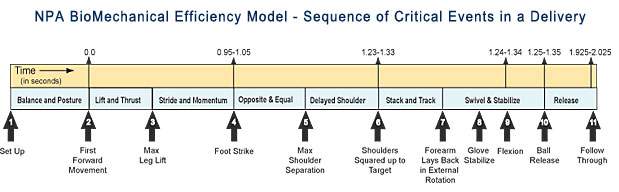


I'd like to focus on TIMING. I realize that there some disagreements with Coach House's sequencing but  I will leave that for another time. Any comments to that can be directed to him. :)


TIMING AND PERCEPTION IN BASEBALL:


As we look towards the skill of baseball, it is easy to break down component parts of the full movement from Set-up to the Follow-through. According to Coach House, there are particular points in time WITHIN the sequence of events that need to occur in a very narrow window of time. These numbers are for elite baseball players and will probably modulate given age and competitive level but they will most not likely deviate too much. However, our sense of "time" and "timing" in sports is integral to our success. In a complex action, like pitching, our brain and body have to be tuned into time or COORDINATED. This "time sense" of course is subconscious, but this should not downplay its importance. 


In a task, there is an inherent rhythm to the movements kept in step by our brain. If that sense of timing is off, then no matter what sequencing we use, it will not be as efficient and more than likely not as effective. This matter of timing is critical in both learning and performing. 


NEUROSCIENCE MEETS SPORTS


Science is now telling us that there are neurons devoted to the sensing of time which are located in the prefrontal cortex and striatum. In an article entitled "Time Keeping Brain Neurons Discovered"  based on the journal paper "Neural representation of time in cortico-basal ganglia circuits" , it suggests that part of the brain actually time stamps tasks that didn't require a specific time requirement; and that the task had dominant peaks in latencies at 100 milliseconds, 110 miliseconds, 150 milliseconds, etc after the initiation of a "go" signal. Interestingly, the neurons that are located in the prefrontal cortex and striatum also play important roles in movement, thought control and learning. 


WHAT!??!?!?!? Is is possible there are subtle peaks times in the brain for optimal learning, thought control and movement??????


BUT WAIT...THERE'S MORE.....


In a study in the Journal of Neuroscience, the researchers found that PERCEPTION has 'on' and 'off' periods where attention is a at its greatest. According to the article, "Timewarp: How your brain creates the 4th Dimension"  "[Prof] VanRullen examined another neural function, called near-threshold luminance detection. He exposed his subjects to flashes of light barely bright enough to see, and found that the likelihood of them noticing the light depended on the phase of another wave in the front of the brain, which rises and falls about 7 times per second. It turned out that subjects were more likely to detect the flash when the wave was near its trough, and miss it when the wave was near its peak."


WHERE IS THIS GOING....


Ok, I know some of the above info was a little dense BUT I am getting to what it has to do with baseball and sports in general. 


As we teach our athletes, students and musicians a skill, it is important for us to recognize that we can access the brain directly to accelerate learning. For instance, Dr. Luke Jones from the University of Manchester discovered that performance of certain tasks could be improved up to 20 percent by causing the internal clock of the brain to speed up artificially by using 10 seconds of clicks (about 5 clicks per second) to stimulate neurons in the brain. TWENTY PERCENT!?!?!?

The theory behind it is that if you accelerate peoples subjective time, "they really seem to have more time to process things," according to Dr. John Wearden, a mentor of Dr. Jones. That's the feeling of the ZONE when everything slows down and you can see things almost moving in slow motion. 

The implications in both learning skills and performance are enormous with the knowledge that we can directly affect the brain through something as simple as clicks on a metronome to improve performance. 

ARE THERE OTHER WAYS TO TWEAK THE BRAIN TO IMPROVE PERFORMANCE? 

Of course! The "Timewarp" article says that  "Edward Large, a neuroscientist at Florida Atlantic University at Boca Raton, has found that rhythmic sounds (like that found in music) can entrain gamma brain waves, causing the beginning of each sound to be accompanied by a burst of several especially strong wave peaks. The click train may entrain other types of brain waves too - perhaps those that correspond to the discrete snapshots in our perceptions. 

VanRullen and Jones agree that this may be the answer. "When you have faster oscillations, you have more snapshots per second," says VanRullen. "You may be more efficient at particular cognitive tasks, and because there are more snapshots in a given time, it may seem to last for longer.  If this theory is correct, the click train is literally resetting the brain's frame-capture rate.


SHOTGUN TECHNIQUE: 


1) Find an online metronome or download something to your smart phone. I have an app called Tempo on my iphone.
2) Set the metronome to about 250 beats per minute (bpm) in 4/4 time using the quarter note as the beat.
3) Try not to have any distractions on music. The rhythm and tempo of the music will affect the experiment. 
4) Compose of 2 sets of of 10 arithmetic problems. They should be all addition, subtraction, multiplication, division, etc. Try not to mix. 
5) Time yourself on how long it takes you to complete the first set
6) With a stopwatch listen to your metronome for 10 seconds at 250 bpm. 
5) Immediately time yourself doing set #2 of the arithmetic problems. 


Where you better on the second set? 


Could this be used when you doing other skill builidng? 


CONCLUSION


Myelination of a neuron
We know that the brain controls everything, so when we can start to understand and accept that, it opens up a whole new world to training like Coach Bruyninckx did. With the "brain centered training" we know that all skills are learned in a progression. When one step of that progression is weak, we will see a breakdown at SOME point of the complete skill. As we begin skills, we learn them in a slower approach and then begin to tweak variables like speed, distance and time. As the brain becomes comfortable with the one step of the skill, an athlete, or whoever, can start to layer and fine tune that step ("myelination")  which will create a natural transition to the next step. Until all steps are learned in an integrated fashion to produce something like an effective and efficient baseball pitch.  


OBVIOUSLY, we cannot stop focusing on the biomechanics, muscle strengthening, fascial connections, etc that is associated with sports. They have their place. Knowing joint positions and muscular eccentric and concentric movements helps us to understand the the positions and snap shots of the task; however, what is important is what is "controlling the puppet strings". 

THE BRAIN. THE BRAIN. THE BRAIN. 


If team, skills and strength coaches recognize this, their results could improve 10-20 percent! Hmmm....I wonder if that's the difference between winning and losing a championship game? You tell me!!!


Thoughts? I'd love to hear them!


Have a great day!


Will

January 10, 2011

Joint movement in Hatha Yoga

Recently, I have been fortunate enough to be able to sit down and chat with a few yoga teachers and discuss "YOGA". For the civilian, Yoga is just the asana or poses. However, for the truly devoted, Yoga is an 8 limb system of how to live your life that goes WAY beyond the physical poses.

However, since that's what most tend to focus on, I decided to focus a blog post to the asana as Part III to my "More than meets the eye" series.

Chatting with these teachers, I realized that the poses are very elusive to many. They tend to just regurgitate instructions from what their teachers said and so on. Rarely do they take the time to break the poses down and understand them.

However, some do go a bit further and focus on the muscles and stretching the muscles which is fine. It's like Step 2 on the never ending yogic journey. So I wanted to write a short post on looking at the asana with the motions of the joints in mind. Here's the thing: you can focus on muscles but they are JUST reactors to the motions of the bones and joints.  If you don't flex your knee or anteriorly rotate your pelvis, you are not going to get any reaction or stretch out of those tight hamstrings.

As always, we will look at the motions of the joints in 3-D and you'll be shocked to know that the joint has over 2,000 possibilities at any given moment.


Here's the short and sweet about 3-D Joint Physiology:

1) A joint is the location at which two or more bones contact. 

2) Joints are tri-planar meaning that they have movement capability in the three cardinal planes: 
  • SAGITAL: Flexion and Extension
  • FRONTAL: Right and Left lateral flexion or right and left lateral translation
  • TRANSVERSE: Right and Left rotation
THESE MOTIONS ARE ALSO CALLED OSTEOKINEMATICS. 

3) Joints have specific movements within them which are usually small amplitude motions called:
  • Roll
  • Glide
  • Spin
THESE MOTIONS ARE CALLED ARTHROKINEMATICS.


Now, this is the simple side of joint mechanics that can get complex pretty quickly. 

Interestingly, within the Osteokinematics, we find an even deeper process.  At each cardinal planar movement, there are 13 ways to get the motions like sagital planes' flexion and extension. Well, if you know that there are 13 ways to get motion in the sagital plane, you know there are 13 ways to get it in the frontal plane so that's 13x13 which equals 169 joint possibilities. Then we have 13 ways to get motion in the Transverse plane so that's 13x13x13 which equals 2, 169 minus 1 for NO MOTION at the joint and you get 2, 168 ways that a joint can move. 


Q: SO WHAT DOES THIS HAVE TO DO WITH YOGA???

I will tell you when I first learned that, I was absolutely floored because here I was thinking one-dimensionally when there was a whole other world out there especially for the yoga asana because we have to work with the joints in the poses. Because poses are generally multi-joint rich, we have a formula for a lot going on all at once.

When we look at the asana, it would benefit all involved parties, especially teachers, to look at the asana with knowledge based in anatomy, physiology and biomechanics and use language that is clear and concise not phrases like "Pop your hip" "Your inner ankle is collapsing" "Balance on your sits bones"(I hate the last one the most).

For better or for worse, yoga teachers are movement therapists in many regards, especially when they get into "alignment". Knowing the anatomy only will deepen your skills as teachers. Understanding physiology and simple joint mechanics will allow you to serve your clients and students better as well as being able to speak on a professional level with health care providers like doctors and physical therapists so that you can be part of a team that can facilitate healing of your client.

I am starting to teach a series of "Anatomy of Yoga" workshops to introduce the science of the body to yoga teachers and advanced students. Having an accurate mental map of your body will only serve you.

As always I welcome in questions and comments you may have. I can be reached at will@3doptimalperformance.com


Thanks!

Will


November 4, 2010

Any Yoga is NOT good Yoga!

WAY TOO MUCH LUMBAR EXTENSION!!! DO NOT TRY THIS AT HOME IF YOU LOVE YOUR BACK!

A few years ago, someone said to me "Any yoga is good yoga" and I reluctantly agreed because I was a budding young teacher and this person had been teaching for a while. To this persons credit, she was (and still is) an AWESOME teacher and must have been comparing her way of instruction to students that resulted in good alignment and form. Unfortunately, not everyone does not have her deep and rich understanding of the mechanics of the poses. Actually, these days, I think its almost the opposite, especially in some of the Power Yoga and Vinyasa classes where getting a workout in is put over proper alignment. 

I have the opportunity to come into contact with hundreds of yoga practitioners per week who may be regular to my class, a drop-in or completely new to yoga. "Open Level" is what we call some of those classes. What I see from some of the non-regular students in their yoga poses forces me to stop class and really instruct on a particulars. Their alignment is all out of sorts but worse off its just plain dangerous and will more than likely lead them to a repetitive stress/strain injury. Some things I see are:

HYPER EXTENDED LUMBAR SPINES
LOCKED ELBOWS
OVERLY TENSE SHOULDERS
OFF BALANCE POSES
OVER ROTATING AT THE LUMBAR SPINE

The list goes on and on. The cause of some of these are structural like tight hamstrings that are compensated for, tight thoracic spine that is compensated for at the Lumbar spine. These can be worked through. But some of these are just from BAD HABITS and what gets me is that these bad habits extremely limit the practitioners progress.

This happens because many yoga teachers do not understand how the body REALLY works. Anatomy is studied but its focused on muscles and not the correct biomechanics of the WHOLE BODY. Understanding how joints and connective tissue all work TOGETHER, based on unifying principles of function, allows the teacher to create an authentic practice.

Simply calling out a pose in class is not teaching. It's reciting lines. Don't get me wrong. I was in that boat once. I am not blameless. However, when I found my way into understanding the body the other parts of my yoga teaching opened significantly and my students really were able to progress physically, mentally and spiritually. If they feel more comfortable in one, they will feel more comfortable in the other two. 

As a teacher and yogi, I am constantly working toward being as authentic as possible. Interestingly, that is where the hard work is. Being fake and artificial takes no work at all.

YOGA TEACHERS: Keep studying the sutras, chanting, inspirational reading, etc up. It's good. Get yourself into biomechanics and functional anatomy. If you want to see your students move with ease, efficiency, grace and power, sink your teeth into the science of movement. Do not be put off by it because it gets technical. GET OUT OF YOUR COMFORT ZONE AND GET TECHNICAL! Your students will keep coming back and getting better and better every week because they will understand the body more. Help them own their practice.

This may ruffle some feathers. That's okay. My intent is to encourage you to study some of the science of yoga as well as the spiritual and mental. They are not SEPARATE!!!!

I will post some videos detailing certain asana soon. If you have any requests, let me know and I will see what I can do.

Any questions or comments can be sent to will@3doptimalperformance.com

Thanks,

Will

October 21, 2010

A quick and dirty functional circuit for a total body workout


Very often, I get emails from friends asking me about a simple yet functional workout.

As many of my client-patients and athletes know, I am all about exercies being multi-planar to be functional. A while back, I wrote the post "3 exercises every athletes needs to do". They are:

LUNGES
SQUATS
PUSH-UPS

Putting the movements into a nice sequence works very well. Because function is TWEAKABLE, this cicuit can be done many ways.

For instance, you can change the number of reps within the circuit from 1-(whatever).

You can do each movement (lunge, squat, push-up) for time before you move to the next one like 45 seconds for lunges then 45 seconds for squats, etc.

You can speed up or slow down the movmements.

You decrease or increase weight of dumbells.

The number of possibilities is ENDLESS but I wanted to just shoot this video out as a INTRO TO FUNCTIONAL FITNESS.

VIDEO DETAILS

In the video, you will see me:

Do the lunge matrix with:

Both arms reaching to knees back to shoulder (bicep curl)
Both arms reaching to ankles to an overhead press

Do squats and push-ups with the single-plane tweaks of:

XXX - Feet/hands neutral
RXX- Right foot/hand forward
LXX- Left foot/hand forward
XWX- Feet/hands wider than hip distance
XNX- Feet/hands narrowr than hip distance
XXE- Feet/hands turned out
XXI- Feet/hands turned in

This circuit can be progressed into the double-plane and tri-planar tweaks, but I will save that for another day.

If you have any questions or comments please let me know.

Best,

Will

October 11, 2010

Functional Pilates for Athletes: Cross-Train like a Pro Series pt. 4


If someone would have asked me if I would take, train and then finally teach Pilates ten years ago, I would have said "NO WAY!"  As a yoga teacher, I even snubbed Pilates as a "yoga knock-off" but after training in the system for the past 6 years, I take it all back.

WHO DOES PILATES?
Originally called "Contrology" by its founder Joseph Pilates, evolved as a system of rehabiltation for injured soldiers during World War II.  Joseph noticed that when the soldiers were able to move sooner, even in hospital beds, they recovered much faster. Over time he developed his system and finally moved to New York City where it became a mainstay of conditioning and rehabilitation for injured dancers, many of whom danced under Balanchine and Graham (both very physically demanding forms of dance). For decades, Pilates was used by dancers not only as conditioning but rehab. However, much like yoga, the tremendous benefits of Pilates emerged and made their way into mainstream America and finally into professional athletics. Thats right! Athletes like Kobe Bryant, Tiger Woods, Jason Kidd and Curt Schilling have all been doing Pilates and swear by this amazing system.

HOW IS PILATES FUNCTIONAL?

Many of my colleagues poo-poo Pilates, but I really think it's because they do not understand it. Their arguement to me is "when are you ever on your back crunching up in athletics? We need to train upright for function because that's where they will be performing." Well, as Gary Gray, PT says "It depends".
Looking back at Fundamental Movements, those included activities like lunging, squatting, running, jumping, hopping, pushing and pulling. However, those movements could also be lying on the back, side, and front. These movements are FOUNDATIONAL movements for us to get into our bodies.

In my last post on FUNCTIONAL YOGA FOR ATHLETES, I mentioned that it develops a greater kinesthetic sense or where and what the body is doing in space. One of the main tenets of Pilates is FOCUSING on your body.  Pilates, done correctly, requires a great deal of precision that will not let people turn their brains off as they may do during an "abs workout". When the movements are refined, it will not only be a "good workout" physically, they will have honed their awareness of their body.

Can Pilates strengthen the core? Sure, but I think it's way deeper than that. On top of the kinesthetic sense, athletes can find Pilates to be restorative in nature. Because they are either lying on the back, side or front for Mat-based Pilates, there is less load to the joints. Also, going through these movements, muscles are being eccentrically loaded and concentrically exploded  while their joints go through their range of motion in a non-weight bearing way. Joints and muscles are able to find more space, mobility and stability during the session.

Below is a quick video of the "5 Abdomnial Series" with an explanation. These five exercises that are done in a "flow" manner are great for starting to turn on all of the nerves and muscles of abs.

As always, I welcome questions and comments.

Thanks,

Will

October 4, 2010

Functional Swimming for Athletes: Cross-train like a Pro series pt. 3


In 2009, I decided I was going to start doing triathlons. The second thought I had was "OH CRAP! I have to actually learn how to swim." Well, this started a search for a swim coach. Being a biomechanist, I immeditaely went to the Internet and did a search for "The Biomechanics of Swimming." Because its such a big field, I had pages and pages of results but I happened to click on TOTAL IMMERSION (TI) SWIMMING and to my surprise, they were dead on for what I needed. The founder, Terry Laughlin, promised efficieny and easy freesytle, so naturally I was encouraged. I eventually got the TI videos and TI book and started woking with a TI coach, and to say my life was changed was a bit of an undesrtatement.

The magic of the TI method is that it is systemically broken down to build or rebuild your stroke so that instead of having a barge-shaped vessel, you are more torpedo or "fishlike" so that you are able to literally glide through the water. The method is VERY 3-D in its approach as it uses all 3 planes of motion to combine into a seemeless technique.

3-D BIOMECHANIC TECHNIQUE OF TOTAL IMMERSION

Transverse Plane: Arms and lets are not used as primary propulsion. Instead, a horizontal rotation of the entire body or "hip-drive" in TI parlance is the engine that moves the body. Terrys' reason being that in longer distances (not sprints), the arms will fatique quickly and the swimmer will not be able to sustain the swim. The larger muscles of the 'core' assist the swim so the smaller muscles do not have to.

Frontal Plane: The arms become more integral in this plane since they are set as "tracks" for balance and stability. They are set wider than shoulder distance, so when the swimmer has a stable point for the rotation to go to.

Sagital Plane: The arms and legs do play a role but not as large as we would think. They do reach forward but only to have "patient hands" that just hold the water and not pull it back. As for the legs, TI preaches a 2-beat kick.

SO WHAT DOES THIS HAVE TO DO WITH CROSS-TRAINING???

As I started swimming more and more, I was not as sore from my other training. The swimming, even for an hour or more, had a very therapeutic affect on me. I was able to workout longer and harder without the fear of overtraining (even in fucntional training). The result was that I improved in nearly everything I was doing from strength, to flexibility, to body awareness to cardiovascular conditioning.

SO WHY DO I NEED TOTAL IMMERSION???

Well, the fact of the matter is that you dont really need the method to just get in the water and do aquatic based conditioning. However, the benefits of someone learning how to swim properly far out weigh the cons of just flopping around in the water. Feeling comfortable in the water and not feeling like you will drown is probably the top reasons why most people do not swim more. They fight water instead of moving with it. My father always told me "Do not fight the water because it will always win." I kept this in the back of my mind when I began my swim training.

With Total Immersion, the athlete is able to go through a step by step process on how to build the stroke up from nothing. If he or she is truly mindful, they are able to not only develop a good stroke, they will have improved their kinestthetic sense which, as I've said in other posts, are a vital to improving athletic ability. Moving through water, you must allow yourself to float and that is done by maintaining a sense of calm and being able to remove excess tension from the body where it doesnt need to be. What we see typically is that when an athlete becomes aware of their body, they are able to move better overall.

ON THE THERAPEUTIC SIDE....

Much research has been done to back up the wisdom of coaches regading aquatic therapy and conditioning. Some of the most cutting edge work is being done by Dr. Jan Prins at the University of Hawaii, who is also owner of Prins Aquatherapy. In a recent keynote speech to the International Society of Biomechanics in Sports, Dr. Prins described the kinesthetics of exercising in the water are:

- Most movements in the water are learned skills and take time to develop.
- Kinesthetic movement in the water is subtle, therefore, efective movement patterns must be developed and then closesly monitored.
-The water reduces the pressure induced loads on the joints and consequently allows continue exercising with decreased risk of internal injury.

Dr. Prins primary population is rehabiltiation but his strategies are still very valid for athletes.

OUR SUMMER WORKOUTS
This summer our athletes would do at least one, sometimes two pool session per week. If they could swim reasonbaly well we would do a pool set that looked like:

100yd freestyle warm-up
50yd kicking drill with kick pad
50 yd upper body pull using buoy between legs

We would then repeat for backstroke and breaststroke. Butterfly was omitted because of how complex it could be.

The guys would repeat this for at least 3 sets. For my guys who could not swim or were struggling, I took through them the Total Immersion freestyle progression. One student in particular was able to improve his stroke so much he was able to swim 1/2 mile easily and started coming in on his own before practices to swim.

For the strong swimmers, we would finish with a 10 minute continuous swim using any stroke they wanted to.

Sometimes it would be a little more conditioning based, so I used the program from Human Kinetics. Again, the effect that it had on their bodies and our recovery cannot be stressed enough how productive it was. Usually the biggers hurdle are athletes feeling comfortable in the water to do this work. Once they do, they LOVE it. Many of my athletes are still doing it on the weekend to stay up on their swimming but also recover from a long week of land-based practices and workouts.

I am posting videos below from Total Immersion. The first is the first of a video presentation that Terry gave at the Multi-Sport expo. The other are from Shinji Takeuchi, a TI master instructor, who has a beautiful form with videos that allow you to see how he started and how much he progressed with TI.


Thank you,

Will


Please click on the video to go directly to Youtube to see the rest of the series. It's worth your time to watch them all for a better understanding of the method.


September 29, 2010

Functional Yoga for Athletes: Cross-Train like a Pro series pt. 2


EDDIE GEORGE, FORMERLY OF THE DALLAS COWBOYS, IN CRESCENT LUNGE (ANJENAYASANA)

In the mid 90's when I started doing yoga as a high school student, it was REALLY weird. I mean, being the only guy out of a few hundred students to do yoga really challenged me physically, mentally and spiritually. However, thanks to my Aunt Tracy, I was far ahead of the Yoga for Athletes movement in the US that exploded a few years ago.

Since the early 2000's, MANY athletes from the high school level all the way up to the professionals have been incorporating yoga into their training and conditioning programs. Many strength coaches, sports coaches and athletic directors have finally "bought into" the many benefits that yoga can have on their athletes and some have even required it! (I love that, by the way).

REAL MEN DO YOGA was a book that I referred to constantly when starting yoga at the high school level. I referenced guys like Shannon Sharpe in the NFL, Barry Zito in the MLB, as well as entire teams like the Philadelphia Eagles and Chicago Bulls who practiced yoga. This somehow made it acceptable.

I can remember the season that we started yoga, our incidence of injuries like pulled groins and hamstring strains decreased dramatically. The guys were more limber and able to stay relatively injury free. It was pretty amazing and we have kept it going ever since.

HOW YOGA CAN BENEFIT ATHLETES

Well, the most obvious benefit is the stretching aspect that the practice can bring to someone. Depending on the type of yoga (Iyengar, Ashtanga, Power, Vinyasa, etc), they will get more or less strengthening, aerobic conditioning, as well as a faster or slower pace. Some folks love the slower and more detailed work an Iyengar class brings while others prefer the athletic and faster pace of a Power or Ashtanga class. I think its up to the person to really see what 'fits' them and go with it. It's easy for people to go to a few classes with one instructor and say "Yoga really isn't for me." That's like saying "Food isn't for me." There are so many ways to approach yoga that become even more diversified by the number of teachers. The possibilities are endless.

Another reason, is that it really starts honing your overall athletic abilities. In a post I wrote on Applied Functional Athletic Development,  I referenced KINESTHETIC AWARENESS or the ability to sense where and what your body was doing in space. This awareness MUST be taken into the yoga practice and when it does, the athlete learns a little more about their body. They appreciate how a bend here or a twist there activates and stretches the soft tissues in the body. This sense can be taken deeper and deeper so that the athlete becomes very familiar with how their body moves. This directly translates to athletic performance so when they need their body to do something big or subtle (such a changing their pitching in baseball a minute amount), they will already have developed the control and sense to do it. PRETTY COOL --- YOGA MAKES FOR BETTER ATHLETES!!!

WHAT TO FOCUS ON...
With all that being said, I think there are areas that athletes need to focus on. I can safely say I've taught hundreds and hundreds of classes over the last 10 years and I've come to see a few trends. For athletes, THE HIPS and the surrounding neuromuscular complex is where I tend to start.

I find the hips are the tightest/strongest/weakest/most dysfunctional area of the body because of our lifestyles. For example, at the high school level, our students sit in classes for 6+ hours per day for years and years and then come out for athletics after academics, lunch and sometimes chapel. They do their 15 minute warm-up and they are off for 2.5 hour practices. Needless to say, imbalances will arise pretty quickly.

Can the foot/ankle complex be locked down because of sitting, bad shoes/cleats, past injuries, etc? SURE!

Can the thoracic spine lack the proper Type I and Type II motion from training and condition that focused solely in the Sagital plane and ignored proper motion in the Frontal and Transverse Planes? SURE!

I have seen when a thoughtful assessment has lead to the discovery of these dysfunctions and really freed the athlete from any neuromsuclar pain and discomfort and then allowed them to move well. I acknowledge all of that, BUT I still start at the hips because they are the power source of the body.

HOW TO START YOGA FOR ATHLETES
Generally, the first physical movement pattern I teach is the Sun Salutation (or Surya Namaskar in Sanskrit). Now, every teacher will teach them a little differently but for the most part, it's the same.

Because of my biomechanics background, I absolutely INSIST on good form as bad form can also injure someone. No one wants to herniate a disk in their spines and especially not from something that is touted as a restorative/preventative aspect of their athletic development.

Below is a video showing the Sun Salutation "A" and Sun Salutation "A" with a Crescent Lunge, like in the above picture with Eddie George  Please make sure that you properly warmed up to do this. Never just jump into any movement especially one that takes you through to (or close to) your end range of motion. This Sun Salutation can be done every. It will take about 10 minutes but you will refreshed and energized afterwards.

If you have any questions regarding the movements, I'd love answer them as well as any questions you may have.

Thanks,

Will

September 20, 2010

3 AWESOME and EFFECTIVE ways to cross-train athletes


Many athletes go through their entire career doing the "regular" activities like lifting weights, running, doing plyometrics, etc. These are all important to development but unfortunately there are hundreds of other ways to develop athletes that are never really pursued unless it pushed by a progressive athletic development team. Fortunately, I have been blessed to be part of a team like this for the past 6 years where we regulary integrated traditional weight lifting, functional training, Yoga, Pilates, swimming conditioning, martial arts and gymnastics. Our success at winning multiple conference championships every year and sending student athletes to top-tier athletic collegiate programs has been a result of good skills coaching, good athletes and a good multi-discipline training and conditioning program.

This summer, I took on the job of not only training and conditioning my high school athletes, I also worked with current collegiate athletes. Many of the guys already had summer programs from their coaches, and I didn't want to fuss with their programs. What I did do was to insert some training that worked on some of areas that were not focused on. We did a lot of functional training with the 3-D Lunge Matrices and 3-D footwork as well as tweaked some traditional lifts like the Power Clean.

We also did some VERY non-traditional work which consisted of:

PILATES
AQUATIC CONDITIONING

At the end of the summer, my collegiate athletes reported feeling stronger, quicker and more flexible than they ever had. Even as I checked in this fall, they are still feeling great and many are still following the program that we did this summer within reason of their primary athletic schedules.

An example schedule looked like this (including their respective school workouts):

Monday: Functional Training
Tuesday: Traditional Lifts and 3-D Lunge and Squat Matrices
Wednesday: Pilates Core work and Functional Balance Training
Thursday: 3-D Footwork, Agility, Speed and Quickness
Friday: Yoga and Aquatics


Athletes were responsible for maintaining their individual sport skills so many would do it after their workouts.

What we saw was the guys were moving better, able to recover faster and maintain a high level of skill work during tournaments and games. Additionally, injuries that had affected the guys during their seasons were able to heal properly and didn't bother them all summer and into their seasons or preseasons.

In the next few posts, I will cover in more detail what we did with YOGA, PILATES AND AQUATIC CONDITIONING and will include videos as well.

Take a look at your workouts. Are you including any cross-training to give your body a rest from its routine and give your brain a chance to create a few more neural pathways from the different activity?

If you want to jump the gun a bit, try this: Instead of going to the weightroom today, look for a beginners Pilates or Yoga class. Get there a little early and tell the teacher you dont have much experience. Teachers LOVE to have new people in their classes and most will give you a little extra attention. Afterall, we want you to come back. (Note: If you are a guy who is nervous about going into a class full of women, SWALLOW YOUR PRIDE AND GO then CHECK YOUR EGO at the door. Not to mention, the women in classes are usually beautiful and I have seen on more than one occasion people chatting it up after class. It's a win-win for everyone!)

How about swimming? Do 2 or 3 pool lengths destroy you and have you rethinking your athleticism? If so, check out TOTAL IMMERSION. It's amazing swimming instruction by revolutionary coach, Terry Laughlin. I went from struggling with 2 lengths to being able to swim a 1/2 mile easily and ready for more. There are tons of Youtube videos as well as thorough explanations of the method by Terry.

I look forward to sharing with you. If you have any thoughts or comments about how you cross-train, I'd love to hear them.

Thanks!

Will


September 14, 2010

How to functionally condition athletes that dominate


After athletes have been able to get a good hold on the FUNDAMENTAL MOVEMENTS that were discusseed in part II of the "HOW TO FUNCTIONALLY TRAIN ATHLETES THAT WIN CHAMPIONSHIPS", we now move onto the ENHANCEMENT MOVEMENTS.

These are the enhancement variables that stimulate conditioning for the intended activity/sport

Functional movement (replicates specfic movement within sport)
Cardiorespiratory training
Speed, Agility, Quickness conditioning
Structural conditioning
Complex conditioning (Power Snatch, Power Clean, Hang Cleans, etc)


As you can see, these movement are a lot more complex than the lunges, squats, skips, jumps, etc that make up FUNDAMENTAL MOVEMENTS. These enhancement movements are as close to the activity/sport as you can get, so having the fundamentals well established will benefit all athletes. It's hard to do Power Clean if you cannot squat properly. The same goes for lunges in 3 planes of motion with Speed, Agiliity and Quickness training. Low mobility and stability (mostability) in the body, in particular the hips, equals `low results from the training. It's as simple as that.

Whenever we take on a new class of athletes, they ALWAYS want to do the sexy lifts like Power Cleans because they think that will get them results faster. Of course they will get some results, but unfortunately, they eventually plateau. As soon as we can convince them to take a month or so off of the "Big Lifts" and focus on the FUNDAMENTAL MOVMENTS, they moan and complain at first, but when they come back a few weeks later, they find that their lifts have skyrocketed WITHOUT them doing any of the lifts. Imagine that!

However, when they do move to the ENHANCEMENT MOVEMENTS we insist that they still do all of the work in 3 planes of motion and not limit themselves to the traditional stances. After all, we are getting them as close to the activity as possible and unfortunately, sports are not predicatble. The movements within the acttivity, must be spontaneous but controllable. The athlete needs to know that they can be in almost any position and be able to decelerate their body eccentrically so that they concentrically accelerate or unload the entire neuromuscular system.

As we look through this functional process, we see that it is a process that when followed, yields results that athletes can take to the field and even to the bank!

I will revisit the ENHANCEMENT MOVEMENTS in future posts to go further in depth on one particular conditioning as well as the various tweaks that can be applied to them.

Here is a video that demonstrates one category of the ENHANCEMENT MOVEMENTS as well as a FOOT POSITION tweak that is applicable to the Complex Conditioning lifts.


This clip is a 3-D version of the Power Clean. Traditionally, the move is taught with the feet facing forward but rarely do we still a symmetrical stance in sports, so we had Tony move into various foot positions to illicit different neuromuscular responses. This should not be attempted until an athlete has a very good grasp on the various positions with low to no weight.


RESULTS: One athlete in particular, as a high school junior (6'2 185lbs- wide receiver), was able to max squat 405lbs  even after he had surgery for a sports hernia about 6 months prior (Note: He was cleared by the doctor for full activity). This athlete did not squat heavy for most of the summer but had been working with the various squats in single, double and triple plane stances, so when it came time for more weight, all of the muscles were able to coordinate to eccentricallly decelerate to a concentric acceleration.

As always I love comments and questions.


Thanks,

Will

September 12, 2010

NEW VIDEO: 3-D JUMP MATRIX Preview

I am fortunate enough to train athletes of many different sports like football, lacrosse, basketball, soccer, baseball, tennis and wrestling to name a few. Each sport and each athlete come with their own set of needs and desires to get better, so I have to really take a look at each sport and person and break down the fundamental movements.

What I hear time and time again is that FOOTWORK IS IMPORTANT. Many of the athletes want to be quicker and more explosive and that can be challenging given the many variables of sports. However, when we go back to our basics, we look at the JUMPING as a fundamental movement of footwork.  When we talk about Jumping, we are referring to movement from 2 feet to 2 feet. As hopping is 1 foot to 1 foot (regardless if its the same foot or moving to the other foot).

To start building the fundamental movements, we will take a simple jump and turn it into a 3-D JUMP MATRIX.

In the video below you will see that the athletes first start jumping with both feet IN-SYNC, meaning they are going in the plane of motion in the SAME direction. We then tweak the jump to be OUT-OF-SYNC so that even the feet are moving in the same plane, they are moving in OPPOSITE directions from each other.

The benefit is that we are training the neuromuscular system to be able to eccentrically load the muscles of the lower extremities from the intrinsic muscles of the feet to the deep muscles of the pelvic floor(and everything in between) in ALL 3 PLANES OF MOTION so that they are able to concentrically unload in a coordinated manner to ensure maximum SPEED, AGILITY AND QUICKNESS.

Can you get all of this from one matrix? Well, my challenge to you is to time yourself in a agility test and write down your results. Do the 3-D Jump Matrix for 10 days then go back and retest yourself. You will be pleased at your results.

You will need to tweak the timing of the 3-D JUMP MATRIX starting with at least 15 seconds for both in-sync and out-of-sync movements in one plane. So in the sagital plane, you would go 15 seconds in-sync and then 15 seconds out-of-sync for 30 seconds total. Rest 10 seconds. Then move on to the frontal and transverse planes. That is one set. Do this for 3 sets and add a set every other day that you do the 3-D JUMP MATRIX.

I'd love for you to report back and tell me what your results were.


Thanks!

Will


September 10, 2010

NEW VIDEO: 3-D COMMON AND UNCOMMON LUNGE MATRICES

Here is a new video with Matt, who is demonstrating both common and uncommon lunge matrices.

The COMMON lunge matrix simulates what would be a motion that we would normally do like stepping to pick a box up, or rotating the hips to turn around.

The UNCOMMON lunge matrix simuates movements we usually dont do normally BUT we still see those movements. For instance, crossover steps in basketball.

Matt started with no arm drivers but then as he progressed, he started to incorporate reaches first to his ankle. He then changed to overhead reaches and then finally combined the arm reaches, going ankle to
overhead reach.

I got a great comment from Jugo who added that these lunges could easily be applied to a basketball progression and I fully agree. Thanks for your insight, Jugo!

As always, I encourage comments and questions.

Thanks!

Will


September 8, 2010

The 3 best exercises that EVERY athlete needs to do

Simple. Easy. Direct.

The three exercises are:


LUNGES
SQUATS
PUSH-UPS

While all three are important just in terms of overall athletic development, I would say that LUNGES AND SQUATS are the ones I have most athletes focus on first. The reason being is that most every sport has a variation of a squat or lunge movement in it.

Football stances are squat positions
Running up and down the court in basketball, soccer and lacrosse are basically lunges.
Heck, even swimming starts are squats to a jump.

These movement are EVERYWHERE in sports, so athletes would benefit by mastering these FUNDAMENTAL MOVEMENTS in all 3 planes of motion.

Of course, squats and lunges are not the only FUNDAMENTAL MOVEMENTS. Add to the list:

Walking
Shuffling
Pivoting
Skipping
Jumping
Hopping
Balancing
Jogging
Sprinting
Pushing
Pulling
Reaching


These FUNDAMENTAL MOVEMENTS are the underpinnings of the next step of ENHANCEMENT MOVEMENTS and finally the ACTIVITY OR SPORT.

In my experience, when basic moves are not solid, there are "holes" in the persons athletic foundation. Again, these holes can easily lead to dysfunction and injury.

Supported by the a sound FUNCTIONAL PREPARATION OF THE STRUCTURE, our athlete is better able to execute with CONFIDENCE anything he is asked to do when his FUNDAMENTAL MOVEMENTS are sound.

In Part III of our "HOW TO FUNCTIONALLY TRAIN ATHLETES THAT WIN CHAMPIONSHIPS" we will go over fun and "sexy" ENHANCEMENT MOVEMENTS that take are starting to look even more like the activity or sport they will participate in.

I WILL POST MORE VIDEOS IN A FEW DAYS OF A LUNGE-SQUAT-PUSH UP MATRIX. CHECK BACK SOON! HERE IS ONE OF THE LUNGE MATRIX.


As always, I love comments and questions.

Thanks,

Will

September 6, 2010

New video: POWER AND AGILITY TRAINING

Here is a quick preview of our Power and Agility Video!

As always, I welcome comments and questions.

Thanks and Enjoy!

Will

May 10, 2010

Applied Functional Athletic Development: A New Paradigm for Athletics

Applied Functional Athletic Development: A New Paradigm for Athletics


(PLEASE MAKE SURE YOU SIGN-UP FOR MY NEWSLETTER!)
In a not too distant past, it would not be uncommon to find an athlete who could compete in multiple sports. Many athletes like Jim Thorpe, Jim Brown, Bo Jackson and Babe Zacharias come to mind in terms of those who were skilled enough to play multiple sports at higher levels. However, an athlete need not follow in their footsteps to be considered an all-around athlete.

Today, the athletic community is finding itself in a different situation. Athletes are specializing much earlier. What we are seeing are better performances but unfortunately, there are more injuries and fewer athletes are able to sustain high performance for an extended career (Gambetta, Athleticsim). Recently, we have seen the rise of performance enhancement drugs like anabolic steroids that have rocked sports like Major League Baseball. Are our athletes finding themselves with their backs against the wall and are willing to risk using known banned substances that have dangerous long-term side effects?

Athletes and spectators realize that many movements in sports are spontaneous. The body must adapt to the demands imposed upon it by the athlete, opponents and the environment. A training system that has athletes go through rigid movements does not allow for the functional fluidity and flexibility of the body.

Applied Functional Athletic Development guides athletes through a process whereby functional movements are introduced, practiced and applied in a global biomechanical sense. Through this process, the athlete increases their overall athleticism as well as their sport specific skills.

March 23, 2010

3-D Feet/Hip/Core/Arm Connection Case Study: Tim Tebows "new" throwing motion

UPDATE 5/2/10: CONGRATS TO TIM TEBOW FOR BEING RECRUITED IN THE FIRST ROUND OF THE NFL DRAFT TO THE DENVER BRONCOS!

There has been a lot of hype regarding Tim Tebow lately. It's a little "Flavor of the Day"-ish so I hesitated to write this post BUT, I think there is a lot to be learned from Tim and his new throwing motion especially regarding Functional Biomechanics as it relates to throwing.

First, I want to just say that I think Tim is a great athlete. MANY MANY MANY folks have been downing him lately and that's their prerogative. If you are going to do this on this blog, STOP. STEP BACK AND ALLOW YOURSELF TO BREATHE.

I am going to say that I will give Tim credit for what he's done. He's gone in and within a few weeks reworked his throwing motion which is not an easy thing to do. However, from most accounts of him, he's a smart athlete which helps when you are unlearning a motion that has taken you through high school to college to winning the 2007 Heisman trophy. If you are interested in learning about the learning process of skills and becoming an expert, I encourage you to check out The Talent Code by Daniel Coyle.

In this post, I will take a look at Tim's "old and his new throwing motions and give a biomechanical analysis of what is allowing him to be more explosive as well as accurate.

December 28, 2009

3-D Movement Focus: Introduction to the Biomechanics of Functional Grappling and Wrestling


I have the distinct pleasure of having many amazing people in my life. Friends, family, students, teachers and mentors. Interestingly enough, a person may fall into one of those groups, but many times, a person may fall into more than one to all of those groups.

One of those people who falls into many of those groups is Kancho Cameron Shayne, creator of Budokon (pictured below). Budokon or "Way of the Spiritual Warrior"  in Japanese, is Kancho Shayne's fusion of Yoga and Mixed Martial arts into a powerful conditioning system as well as an effective Mixed Martial Arts format combining Olympic Style Tae Kwon Do, Karate, Kung Fu, Capoiera and Brazilian Jiu Jitsu.


In talking with Kancho, we discussed how to appropriately get across the Principles of Grappling to our students with particular focus on leverage and angles of force. Through Applied Functional Science and the Principles of Function, I will go over more strategies and techniques that focus on the Chain Reaction Biomechanics of Grappling and Wrestling so that you can go into a situation with more knowledge, so that the application in "live" situations comes much easier.


December 3, 2009

3-D Movement Focus: Functional Wrestling and Grappling

A few weeks ago, I had the pleasure of seeing the football team I work with win their conference championship. It was quite a feat for our athletes who may not be the biggest guys on the field, but they usually are the scrappiest. They worked very hard all summer long with the 3-D Training and Conditioning that included not only physical training but also mental and spiritual training. Spiritual training in the sense of having them be encouraged, successful and inspired to be play football. Congrats to the 2009 Bulldogs!

When the fall season came to a close, I was able to shift gears into our winter season that includes Basketball, Hockey and finally WRESTLING which I am involved in.

BRIEF HISTORY OF WRESTLING

Wrestling, to me, is one of the most fundamental activities that a person can take part of. It is also one of the oldest MARTIAL ARTS practiced thousands of years ago by many countries like Greece, China, and Egypt to name a few. Over time, wrestling has evolved into various forms, and the two most practiced in the United States are Greco-Roman and Freestyle Wrestling, both of which are Olympic sports.

The history of wrestling is dependent on the country but the overall principle is that it is a martial art or art of warfare ("martial" deriving its name from the Mars, the Greek god of war). Wrestling was used in war situations that required hand to hand combat as well as in peace time where it was used to condition and prepare the soldiers for battle. It also was one of the first sports at the 1st Olympiad and continues to this day.

November 11, 2009

3-D Movement Focus: The Art and Science of Hatha Yoga


(Dedicated to all members of the US Armed Forces, past and present)

I have been a yogi since 1996, and every year I learn something new about the practice. It is truly amazing and I am going to give my teacher Paula D. Atkinson props again. She is such an inspiration for me doing yoga.

As I traveled down my yogic path, I discovered so many nuances about the practice. However, these nuances left me with many questions. With the Mind/Body/Spirit aspect of yoga, I came to realize that when you work with one of the aspects, you are really working with all of them. However, I think a big question in my mind was "Why and how is yoga such an efficient stretching practice?" To me, it's way above any other stretching protocol. I recommend the practice to anyone who wants to change their lives. However, the question of "WHY AND HOW IT IS SO EFFECTIVE?" remained.